Índice
- Why is secure pipe and tube fastening crucial in data centre fire suppression systems?
- Mechanical safety as part of system reliability
- What are the advantages of Block Clamps made from flame-retardant Polyamide PA-V0?
- When are aluminium clamps suitable for fire-extinguishing systems?
- How does choosing the right clamp support long-term operational reliability?
- What sizes and mounting options are available for cable fastening?
- Why are clamp solutions an important component of critical infrastructure?
- FAQs
Why is secure pipe and tube fastening crucial in data centre fire suppression systems?
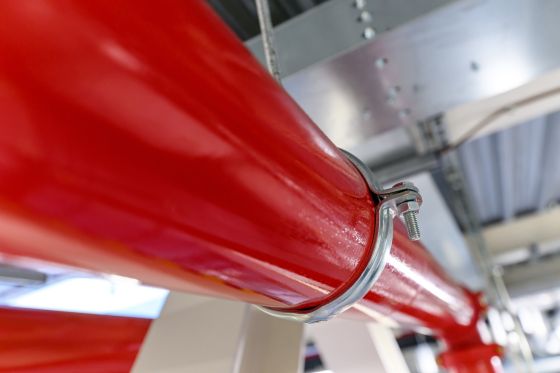
The reliable securing of pipe and tubes is a key component of the mechanical design of fire suppression systems in data centres. Secure, precisely defined pipe and tube routing helps to reduce movement, vibration and mechanical wear. This ensures the reliable operation of the installation throughout its entire service life.
This is particularly important in data centres. Modern fire detection and suppression systems form part of the protective infrastructure of the white space. At the same time, pipe- and tubework and other mechanical systems are integral to the technical infrastructure of a data centre. Across both areas, the focus is on operational safety, defined material and quality standards, and long-term availability.
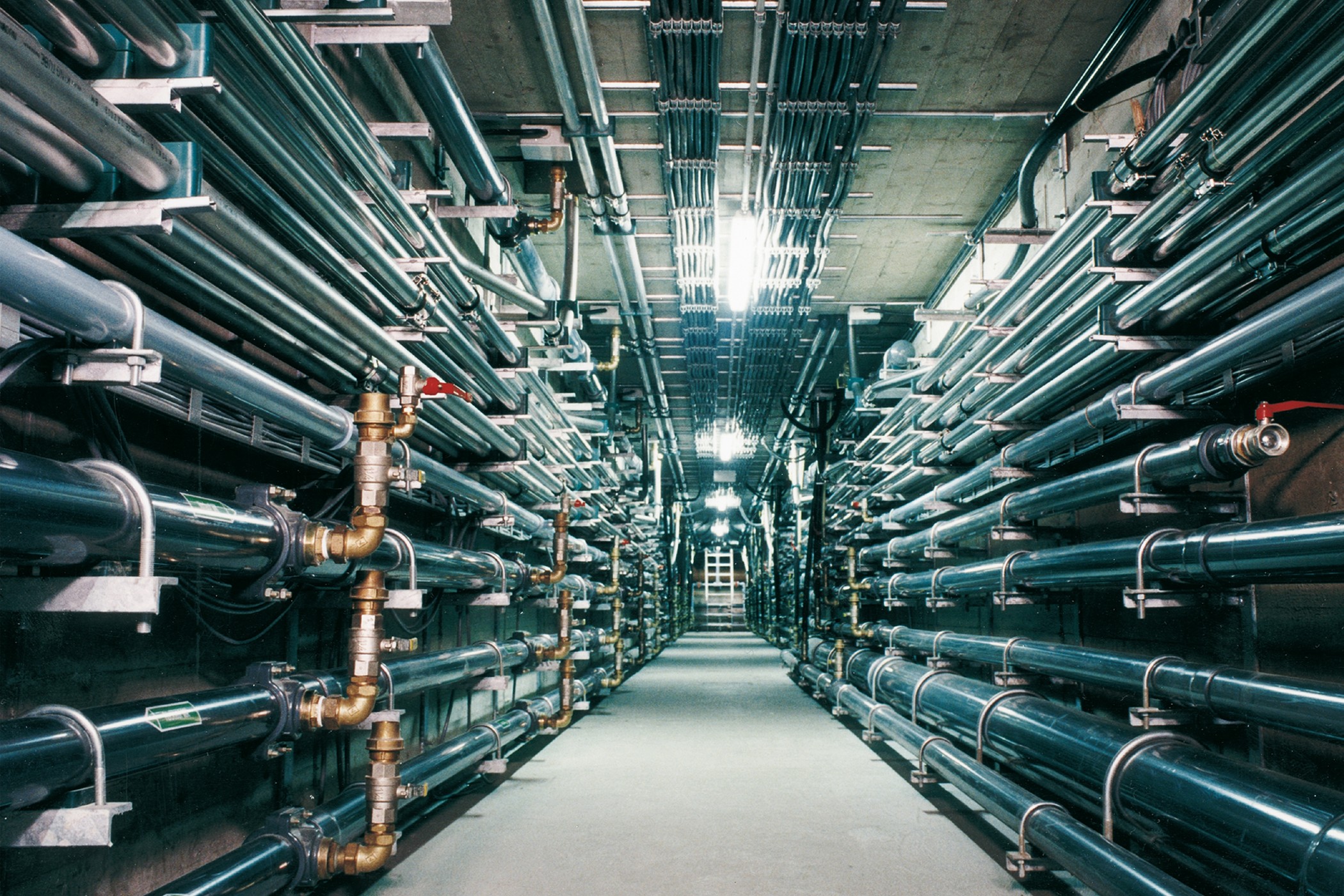
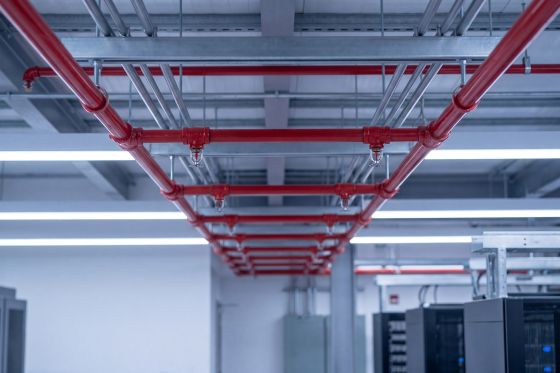
Gas-based extinguishing systems and water mist extinguishing systems place particular demands on their components. In addition to valves, nozzles and distribution pipes and tubes, consideration must therefore also be given to how pipes, tubes and conduits are laid, separated from one another and mechanically secured.
We offer a range of clamp solutions for these tasks. Depending on the technical requirements, options include Block Clamps made from flame-retardant plastic and aluminium, amongst others. Selecting the appropriate seal material and design makes it possible to tailor the fastening to the installation situation and the requirements of the respective fire-extinguishing system.
Mechanical safety as part of system reliability
Fire-extinguishing systems are safety-critical installations whose operation must be reliably guaranteed in an emergency. The mechanical components may be subjected to various stresses.
These include, in particular:
Pressure loads during system activation
dynamic forces and vibrations
temperature fluctuations
Environmental influences over long periods of operation
Careful positioning of the cables helps to limit unwanted movements and contact between adjacent components. At the same time, forces can be transferred to the mounting structure in a more controlled manner.
For data centres, this approach forms part of an overarching principle: whilst ‘white space’ and ‘grey space’ differ in terms of their technical requirements, they both rely equally on reliably designed components that function stably over the long term. In the more industrially oriented ‘grey space’, factors such as robustness, resistance to media and suitability for continuous operation play a key role.
Cable fastening should therefore be considered as part of the overall system right from the planning stage, rather than merely as a detail of the subsequent installation.
What are the advantages of Block Clamps made from flame-retardant Polyamide PA-V0?
For applications where corrosion-resistant seal materials with defined fire behaviour are required, we offer Block Clamps made from flame-retardant plastics.
One relevant variant is flame-retardant Polyamide PA-V0. The Seal Material combines the structural properties of a plastic clamp with defined behaviour in the event of a fire. The Clamp Bodies are classified to UL 94 V-0. The material is self-extinguishing and does not exhibit burning drips. LSZH / Low Smoke Zero Halogen (low-smoke and halogen-free).
These properties are particularly important in areas with heightened fire safety requirements. After all, the choice of material is not solely about the mechanical fastening of the cable. The behaviour of the installed materials in the event of a fire must also be suitable for the specific application.
In addition to their fire behaviour, PA-V0 cable clamps are characterised by properties that are relevant for technical installations operating over the long term. These include good resistance to temperature fluctuations, as well as resistance to UV radiation and various environmental influences. For a specific application, the material properties and compatibility with the media must always be assessed against the conditions of the relevant system.
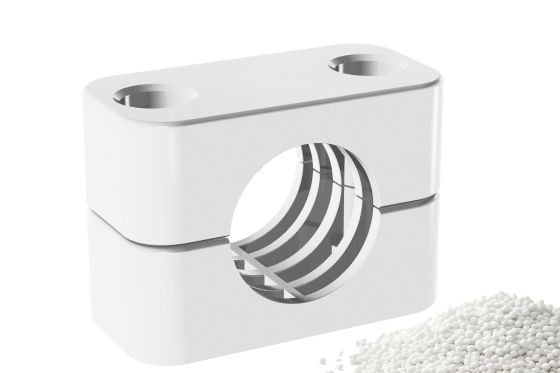
The design of the clamps’ inner surface can also be adapted to the pipe- and tubework. For rigid pipes and tubes, clamps with pre-tension and profiled inner surfaces ensure precise positioning and force transmission. In the case of flexible hoses, however, smooth inside surfaces and rounded edges may be advisable to protect the hose cover and reinforcement layers from unnecessary mechanical stress.
This means that the clamp is not merely a fixing point; it performs a specific mechanical function within the pipe- and tubework.
When are aluminium clamps suitable for fire-extinguishing systems?
Where non-combustible seal materials are required or preferred for design reasons, aluminium Block Clamps offer a further option for securing pipe- and tubework in fire-extinguishing systems.
Aluminium itself is non-combustible. Consequently, these Clamp Bodies do not exhibit the burning or dripping behaviour typical of plastics. This makes this material particularly suitable for applications where the choice of material plays a key role in terms of fire safety.
Added to this are mechanical and environmental properties. Aluminium clamps offer high resistance to temperature and media, as well as good resistance to UV radiation and weathering. The strength-to-weight ratio also enables robust designs without unnecessarily high component masses.
For rigid pipes and tubes and pipe- and tubework, profiled inner surfaces can support reliable fastening and uniform positioning under both static and dynamic loads.
This makes aluminium clamps an attractive solution, particularly for water mist extinguishing systems, exposed pipe- and tubework and installations in technical areas. Here, too, the specific system design remains crucial: the clamp material, pipe and tube type, method of installation and environmental conditions must all be considered together.
How does choosing the right clamp support long-term operational reliability?
In fire-suppression systems, many mechanical components must fulfil their function over a period of years. This makes it all the more important to take into account not only the immediate stresses during activation but also normal system operation when designing the system.
Stable pipe- and tubework routing and defined mechanical fastening can reduce the risk of various long-term effects. These include, for example, friction wear and abrasion, fatigue resulting from recurring stresses, and undesirable changes in the position of the pipe- and tubework.
The choice of seal material is part of the overall design. Flame-retardant PA-V0 and aluminium offer different properties, meaning that the seal material and clamp design can be tailored to the specific application.
This long-term perspective is particularly relevant for data centre infrastructure. High operational reliability, long-term availability, maintainability and defined material standards are among the common technical requirements for both white space and grey space.
The correct fastening method can therefore also support maintenance and servicing processes. A neatly structured cable routing system facilitates navigation within complex installations and creates clear mechanical conditions.
What sizes and mounting options are available for cable fastening?
Data centres do not only place high demands on technical reliability. The available installation space can also have a significant influence on infrastructure planning. Pipes, tubes and hoses often need to be co-ordinated with numerous other installations.
Our range of pipe and tube clamps therefore includes numerous metric and imperial diameters for different pipe, tube and conduit sizes. Many standard sizes are usually available from stock, which can facilitate flexible planning and short lead times.
There are also various options available for installation. Depending on the specific design, clamps can, for example:
be fixed directly to suitable substructures
be arranged one above the other on multiple levels
be installed on mounting rails and suitable profiles
Direct mounting on the floor/a substructure, on the wall, or under the ceiling
This modular principle allows the routing of pipes, tubes and cables to be adapted to different system layouts. This can be particularly advantageous where pipe- and tubework needs to be routed in confined spaces or where different media and supply systems need to be kept separate from one another.
Space requirements are also a key consideration in the general planning of data centres. In the white space, for example, the focus is on compact designs and neat installation, whilst in the grey space, robust solutions for pump, cooling and pipe- and tubework systems are required.
Why are clamp solutions an important component of critical infrastructure?
A clamp is a comparatively small component. Nevertheless, its role within a safety-critical installation is clearly defined: it holds pipes and tubes in their intended position and ensures mechanically stable pipe and tube routing.
In the case of gas and water mist fire-suppression systems, several factors must be considered together. These include the type of pipe- and tubework, mechanical loads, temperature and environmental conditions, the required fire protection, and the design specifications of the respective system.
With a variety of seal materials and designs, clamp solutions can be specifically adapted to these conditions. Block Clamps made from flame-retardant PA-V0 are ideal when, in addition to mechanical properties, requirements such as electrical non-conductivity and defined fire behaviour are necessary. Aluminium offers an alternative for applications where a non-combustible metallic material is required.
For us, it is crucial not to view the clamp in isolation. In modern data centres, numerous technical systems are interlinked. Our article‘White Space and Grey Space in Data Centres’ already demonstrates that reliably designed components, pipe- and tubework systems and standardised industrial solutions are important both for the immediate IT environment and for the supporting infrastructure.
It is precisely within this overall context that suitable solutions for pipe , tube and hose fastening fit in: as a functional component of a mechanically stable infrastructure designed for long-term availability.
FAQs
Why are pipe and tube clamps important for fire suppression systems in data centres?
Pipe and tube clamps ensure a defined mechanical fastening and routing of pipe and tubes. They can limit unwanted movement and help to reduce stresses caused by vibrations, friction and other mechanical influences. Particularly in the case of safety-critical fire suppression systems, a professionally designed fixing system thus supports the long-term functionality of the installation.
What advantages do PA-V0 clamps offer in fire protection applications?
Block Clamps made from flame-retardant PA-V0 combine the structural advantages of a plastic material with defined fire behaviour. The clamps are classified as UL 94 V-0, are self-extinguishing and do not exhibit burning drips. They also offer properties such as electrical non-conductivity and resistance to various environmental conditions. Their specific suitability must be assessed on a case-by-case basis.
When should aluminium clamps be used in fire suppression systems?
Aluminium clamps are particularly suitable for applications where non-combustible Seal Materials are required or preferred for design reasons. They also offer high resistance to temperature and media, resistance to UV radiation and weathering, as well as good mechanical properties. This makes them a potential solution for, amongst other things, pipe- and tubework in water mist fire-extinguishing systems and technical infrastructure areas.
Are STAUFF clamps suitable for gas and water mist fire-extinguishing systems?
We offer various clasp materials and designs for securing pipe- and tubework in such applications. Which design is suitable depends, amongst other things, on the type of pipe- and tubework, mechanical load, medium, temperature, fire safety requirements and installation conditions. The selection should therefore always be based on the specific technical requirements of the respective fire-suppression system.
What installation options are available for pipe and tube clamps?
Depending on the design, clamps can be fitted directly, arranged on multiple levels, or installed on mounting rails and suitable profiles. This allows the pipe- and tubework routing to be adapted to the spatial and structural conditions of a facility. This modular approach provides additional flexibility, particularly in complex or confined installations within data centres.
Are STAUFF clamps available in different diameters?
The range includes metric and imperial variants for different pipe, tube and cable diameters. Many standard sizes are usually available from stock. This means that different cable dimensions within a single project can be accommodated with suitable fastening solutions.

Newsletter subscription
Sign up now and never miss another post!